Tuesday, December 18, 2012

The 30 meter tower

Beside the ARO building there is a 30 meter tower where several meteorological instruments are located, either 2 meter, 10 meter or 30 meter above ground.Yesterday afternoon I mentioned to one of my colleagues that I think you would have an excellent view from up there, and he agreed. And offered that I could go up there if I wanted to.

So this morning I did it. The weather was not suitable for Dobson measurements, so I had some time at my disposal. My colleague came with me, and we climbed up many, many narrow stairs with lots of space to look down and out at the side. All the way to the top. Being up there, totally exposed, was pretty scary at the beginning, and I was super careful when I took my camera out of my bag. Didn't want to drop it 30 meters down! But although the weather was not the best, the view from up there was just incredible. You can see the whole station setup, and that there is really, really nothing else around.

 So this is the view. You can see the station, the summer camp behind the station, all kinds of storage containers behind the station, and our foot path leading to ARO. If you look really closely you can see the Ceremonial Pole to the right of the station, and the Geographic Pole right in front of the silvery entrance building on the left side of the station. And of course you can see the halo around the sun. And that there is not much more than the station...

 Here is the proof that I actually did climb all the way up to the top of the tower. And that I did not just send my camera up with my colleague.

This is a close-up of the summer camp. The blue half-round structures are accommodation buildings for people who cannot be put in the main station because of limited space. They are called hypertats. Behind those you can see all kinds of wooden storage containers. And the big building in front (slightly to the right) is where the balloon filling facility is located.

Cosmologists

Last Sunday I went to hear the science talk of the week here at the South Pole. The talk was about the South Pole telescope (SPT), its history, and its scientific purpose. The speaker did a really good job explaining the theory of the Big Bang and how they try to find evidence about it in the microwave background radiation of space.

At the end of his talk, the speaker pointed out that the free SPT T-shirts will arrive in January (darn, I will miss out on that one!), and that there will be a Ladies Night at the telescopes (they have several here) this Friday. First it didn't bother me much that I will miss that event as well, however, later on Sunday evening I saw the announcement below pinned at the wall in the women's bathroom. After reading in detail what the Ladies Night would offer, I have to say,  that I was super amused by the announcement, and at the same time really disappointed that I will miss that! Come on, who can say that they slow danced with a cosmologist at the South Pole?!


Almost on the way back

Well, I just dropped off my bags at the bag drag station here at the Pole. I am scheduled to fly out tomorrow (to McMurdo, and then the day after to Christchurch). It is kind of sad to think that I will have to leave the Pole so soon already. Now, that I am finally adjusted to the altitude, and that I find my way around the station.

Work went well. We compared the two Dobsons and the data looks good. Unfortunately that means that there is no scientific reason for me to stay longer. And personal reasons do not really count here. I asked how big my chances are that I will actually make it off the continent before Christmas (because IF I will get stuck here in Antarctica, I would prefer to be stuck at the Pole, where I know people now, rather than McMurdo), and they told me that this time of the year the weather is normally stable enough that the planes can fly, and if there are no mechanical problems. So when I asked if it would be possible to stay at the Pole for Christmas, they told me that this would not be an option, unfortunately, since the station will be completely occupied. Unless, of course, I am stuck here because the planes can't fly...

So, most likely my time here in Antarctica will be over shortly. I really, really liked it here. Antarctica is a very special place and I am just very happy that I was allowed to come here. If everything works as planned, I will be in NZ shortly before Christmas, and will stay there for some vacation, summer feeling and long showers, until the mid of January.

Monday, December 17, 2012

My way to work

I have to walk about a quarter mile from the station where I sleep and eat (and hang out) to the ARO building where I work. I mentioned before that I basically directly walk past the Geographic Pole, but I thought it would be nice for you to see HOW close I actually walk by... :)

 
I stopped about quarter of the way out to ARO and turned around. You can see the South Pole station, and the path of packed snow where we walk on our way out to ARO.

 Turning 90 degrees to the right from the point I stopped, that's what I see. As I said, the Pole is really, really close to the path! 

Turning another 90 degrees and I can see the path leading to ARO (the blue building). In this picture you can also see the 30m tower where I will (hopefully) climb up tomorrow. 

Inside the station - part 2

Here are some more pictures from the inside of South Pole station.

 This is the Arts and Craft room. Where you can find everything you need to do craft works: sewing machines, knitting needles, paint, wood etc.

 The Greenhouse. People who overwinter grow fresh lettuce in here. During summertime it is way cheaper to fly the fresh vegetables and fruit in from McMurdo (ultimately of course from New Zealand), than growing something here. That's why it is kind of empty. The humidity in this room, however, was a treat! Still way higher than in the rest of the station. And they even have a couch in there...


The mail distribution center where I found my letter yesterday in the little shelf labelled with an "H". To the right you see the entrance of the station store. I think I have been in there every single evening...  :)

 The science lab. Most of the scientists sit here and work. Only sometimes they go out to their instruments and check on them. But, we people from ARO have our own little sience lab in the ARO building, so we DO actually go out every day. 


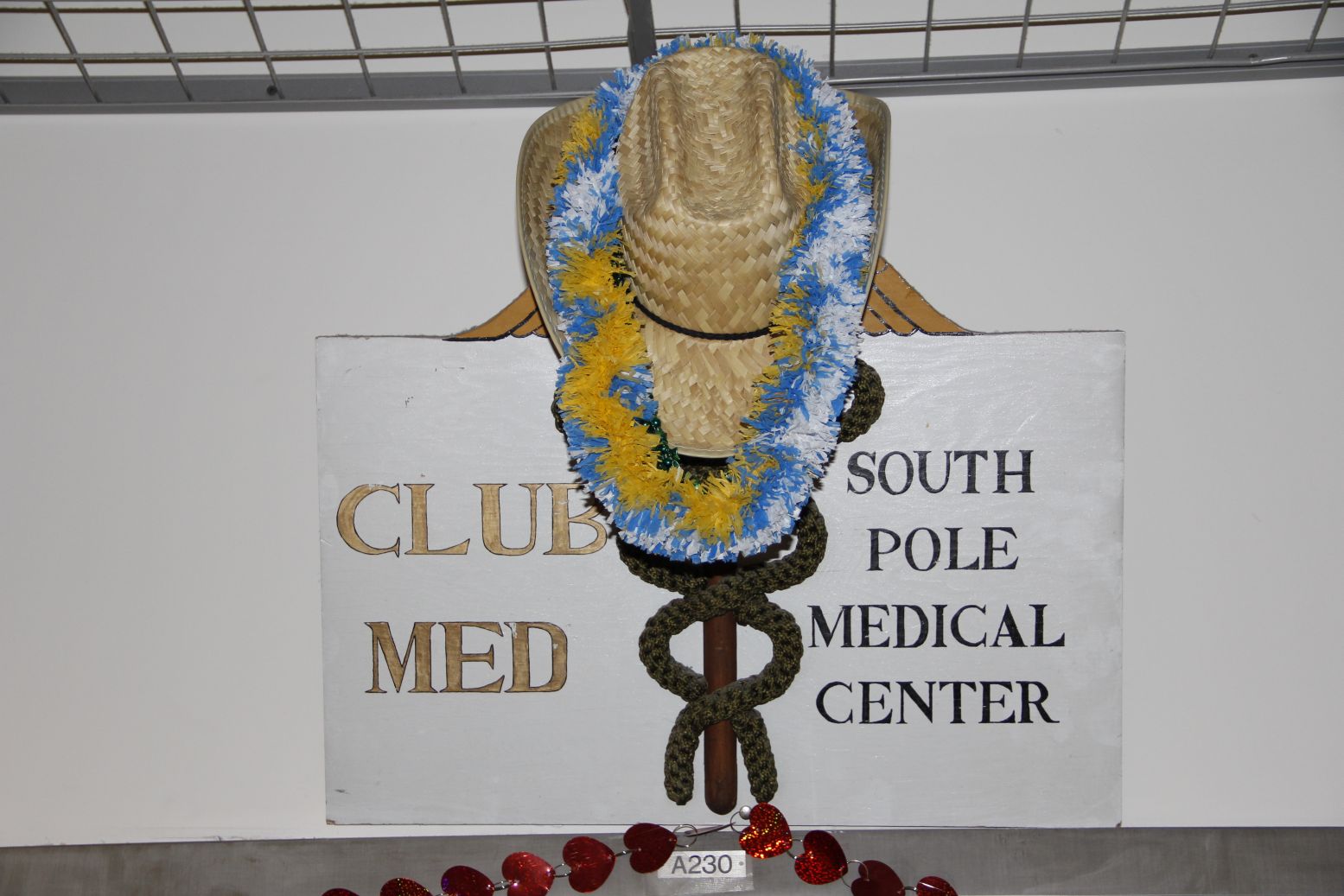
The entrance to the medical station...

 The hallway to go to the rooms in one of the station wings. There are two hallways per wing, and from each there are rooms located on the right and on the left. 

 My room. Photo taken from the door in direction to the bed.

 My room again. Photo taken from my bed in direction to the door. Note "Big Red", the puffy down jacket to the left, hanging there at my door. The little white stripe is my name tag...

Science at the South Pole

Ok, I have to admit that I got the following short pieces describing the different science project here at the South Pole from the South Pole intranet. They describe in short what experiments go on here, and they do a much better job than I could possibly do...

The area around the South Pole is divided in four main sectors for scientific reasons: the Quiet Sector, the Clean Air Sector, the Dark Sector and the Downwind Sector.

Quiet Sector: "Seismology (measurement of earthquakes anywhere on Earth) and radio detection experiments take place in the Quiet Sector, where radio emissions and vibrations created by people at the Pole are kept to a minimum. The Quiet Sector is grid-southeast of the station.
Because the Pole is at the spin axis of the Earth, it is uniquely situated to measure global seismography and long-period oscillations of the Earth. There are no earthquakes in the area and very few seismic monitoring sites anywhere in the Southern Hemisphere."

Clean Air Sector: "The Clean Air Sector is located grid-northeast of the station. The Atmospheric Research Observatory (ARO) is located within the Clean Air Sector and houses climate research and aeronomy projects. Because winds persistently blow toward the South Pole from this direction, the air has been virtually untouched by biota or pollution for thousands of miles - it is some of the cleanest air on Earth." - That's where I sit right now, and where I do the Dobson measurements every day.

That's the Clean Air Sector. I took the photo from the roof of ARO. You can see that there is absolutely nothing as far as you can see. The only people allowed in that sector are the people working at ARO. And then only if they have to take air samples.

Dark Sector: "The Dark Sector is grid-northwest of the station. This sector is maintained with minimal interference from extraneous sources of light and other electromagnetic radiation. Microwave, infrared, and high-energy neutrino telescopes are located within the Dark Sector, as are the Martin A. Pomerantz Observatory (MAPO), which serves as headquarters for many Dark Sector projects, and the Astronomical Submillimeter Telescope/Remote Observatory (AST/RO)."

These are the telescopes of the Dark Sector. The one to the right (with the silver antenna) has a diameter of about 10 meters.

Downwind Sector: The Downwind Sector is located grid-southwest of the stations. It provides an area for balloon launches, aircraft operations, and other “downwind” activities. That's where the runway for the planes is and where the planes arrive.

Sunday, December 16, 2012

Hand washing

One of the things that surprised me most when I arrived here, was the constant reminder to wash or sanitize your hands. Starts in the galley, where you have hand sanitizer dispenser at the walls so that people can use some of it before they tough cutlery, plates or food. Then there is sanitizer in the computer room to use before you start using a computer there. One of the IT guys who connected my laptop to the internal South Pole station network, shook my hands when we got introduced, and then used hand sanitizer right away with the comment "no offense, but better be careful"...

And then there is of course the bathrooms where you have special soap, instructions on the wall on how to wash your hands properly (1. get water on your hands; 2. get soap on your hands; 3. rub your hands together to disperse soap on all possible hand surfaces - about 10 to 15 seconds; 4. rinse your hands well; 5. dry your hands well), and there is even a anti-bacterial hand lotion.

I started to wonder why the hand hygiene was so incredibly important. And I learned that in such a close community like here on station, germs spread fast, and if one person is sick, it is basically only a matter of time until the whole station is sick. And here on the altitude the station is on, it takes very long for the body to cope with sickness. Everything is just so incredibly exhausting.

So with the hand washing, people try to prevent germs to spread, and therefore keep people in working order. As I mentioned before, the South Pole is not really a holiday destination. People are here to work, and keep things running. So half of the station population being sick would not go so well with this approach...